Which Parquet Pattern Suits a Palm Beach Home?

Updated: Nov 12

A guide to the classic parquet patterns, how each one reads in a coastal house, and what it takes to lay them well.
Planning a project? Talk with Joe Avila: call 908-232-6600 or book a virtual consultation.
Parquet turns a floor into a piece of design. The same oak that reads quietly as plank becomes rhythm, texture and a sense of history once it is cut and laid in a pattern. Here is how the classic patterns compare, and what each asks of a house built on a concrete slab in coastal air.
What Counts as Parquet

Parquet simply means wood laid in a repeating geometric pattern rather than in straight runs. It can be made from individual strips assembled on site, or from factory-made panels in which the pattern is already built, the same choice between site work and factory work we weigh in prefinished versus site-finished floors.
Most parquet sold today for slab homes is engineered, with a hardwood face over a stable core, which suits Palm Beach humidity far better than thin solid blocks glued straight to concrete. The pattern you choose shapes the room more than almost any other decision, so it is worth seeing several before settling.
Herringbone

Herringbone is the pattern most people picture first. Rectangular boards meet at right angles with their ends offset, creating a zigzag that feels lively but familiar. It works in almost any room and suits both traditional and pared-back interiors, from a kitchen to a formal hall.
Because each board steps past its neighbor, the pattern hides small variations in color well and gives a sense of movement along a hall or through a long living room. We compare it in detail with its close cousin in herringbone or chevron.
Chevron

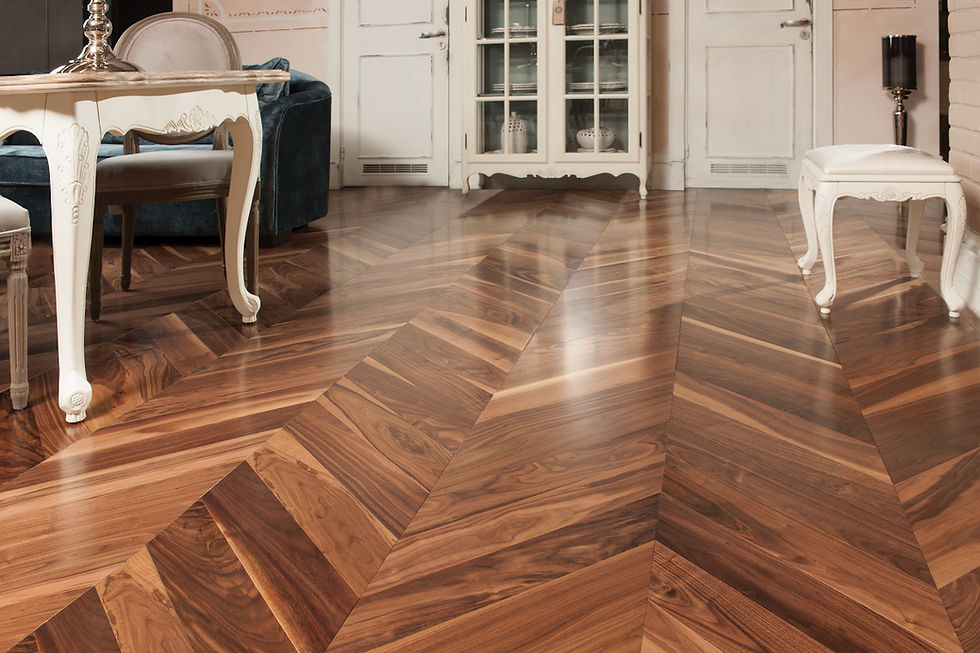
Chevron boards are cut at an angle on the ends, so they meet in a clean point rather than overlapping. The result is a crisp, continuous V that reads more formal and more directional than herringbone. In French it is called Point de Hongrie, and it has long been a favorite in European oak.
The angle matters. A 45 degree cut gives a sharp, graphic line; a shallower 30 degree cut gives a longer, calmer arrow. In a room with long sight lines toward the water, chevron can lead the eye beautifully, and it looks especially refined in rift and quartersawn oak.
Deciding between patterns? Talk it through with Joe Avila.
Basketweave

Basketweave arranges short boards in small square groups, alternating direction from one square to the next, like a woven textile. It is quieter than herringbone and has a tailored, almost architectural calm, and it is one of the classic patterns covered in what wood flooring pattern is best for you. Square groups also make it simple to center in a small room.
It suits studies, dressing rooms, libraries and smaller rooms where a big zigzag would feel busy. Because the boards turn in every square, it also shows less of the directional shading that light and dark finishes can reveal on long planks.
Chantilly and Versailles
Versailles and Chantilly are panel patterns from French tradition. Versailles is a large square of interlacing diagonal strips within a frame, the pattern of grand salons. Chantilly is related but simpler, a square panel with a diamond or lattice set inside a frame. Both read best in rooms with generous proportions and good light, much like the wide plank floors they are often paired with in adjoining spaces.
Both are made as panels and laid like large tiles, often with a border around the room. They are the most formal parquet choices and the most demanding to lay, as we explain in our guide to Versailles parquet.
The Specialist Detail: Left and Right Boards

Herringbone and chevron strips are not interchangeable. Because the tongue and groove must lock in two directions, each pattern needs left-hand and right-hand boards, often labeled A and B. A delivery short on one hand stops the job, so check the count of each before installation begins, and order extra of both, as our guide to how much flooring to order explains.
Every pattern is laid from a reference line, usually centered on the room's main axis, a fireplace or the view. Starting square and centered is what makes a pattern look intentional at doorways and walls. It is one of the first things an NWFA-certified inspector checks when a patterned floor looks wrong.
Planning a patterned floor? Book time with Joe Avila.
Humidity, Slabs and Movement

Parquet has one natural advantage in humid air: because the boards run in more than one direction, their movement partly cancels out across the floor rather than adding up across the width of the room, which helps limit the gaps and cupping that can trouble wide boards. That makes a pattern more forgiving than a run of wide solid plank.
It still needs the same care as any wood floor: a tested and sealed slab, a moisture barrier the manufacturer approves, acclimation in a running house and a perimeter gap. Panels and strips should be glued with the adhesive the maker specifies, which keeps a pattern flat and quiet.
Borders, Scale and Finishing

A border of one or two boards around the room frames a pattern and hides the cut ends at the walls. It is also the natural place to change direction at doorways or to add a contrasting species, such as walnut around an oak field.
Scale the pattern to the room: longer, wider pieces for large open plans, smaller ones for intimate rooms. Finish with a low sheen, which lets the pattern read through the light rather than glare, and test it on real panels with our guide to oil and polyurethane. Then order physical samples and view them in place.
Quick Answers
What is the most popular parquet pattern? Herringbone is the most widely used. Its offset zigzag suits almost any room and both traditional and modern interiors.
What is the difference between herringbone and chevron? Herringbone boards meet at right angles with their ends offset. Chevron boards are cut at an angle so they meet in a clean point, forming a continuous V.
Is parquet good for humid climates? It can be. Because boards run in more than one direction, movement partly cancels out. It still needs a tested slab, a moisture barrier and steady indoor air.
Why do herringbone floors need A and B boards? The tongue and groove must lock in two directions, so the pattern needs left-hand and right-hand boards. Running short of either stops the installation.
Talk to a Palm Beach Wood Flooring Specialist
Call Joe Avila at 908-232-6600 (9 a.m. to 5 p.m. Eastern), email joe@hugginsflooring.com or book a virtual consultation. You can also explore inspections and consultations, wood flooring samples and our collections.
About The Author
Joe Avila leads Palm Beach Wood Floors, a Huggins Wood Floor Specialist brand, and brings 26 years of hands-on wood flooring experience. He is an NWFA-certified wood flooring inspector, installer and sander, and for more than a decade he has taught accredited continuing education programs for AIA, ASID and IDCEC audiences, training thousands of architects and design professionals in the proper specification of wood flooring.


Comments