Herringbone or Chevron: Which Suits a Palm Beach Home?

Updated: 6 days ago
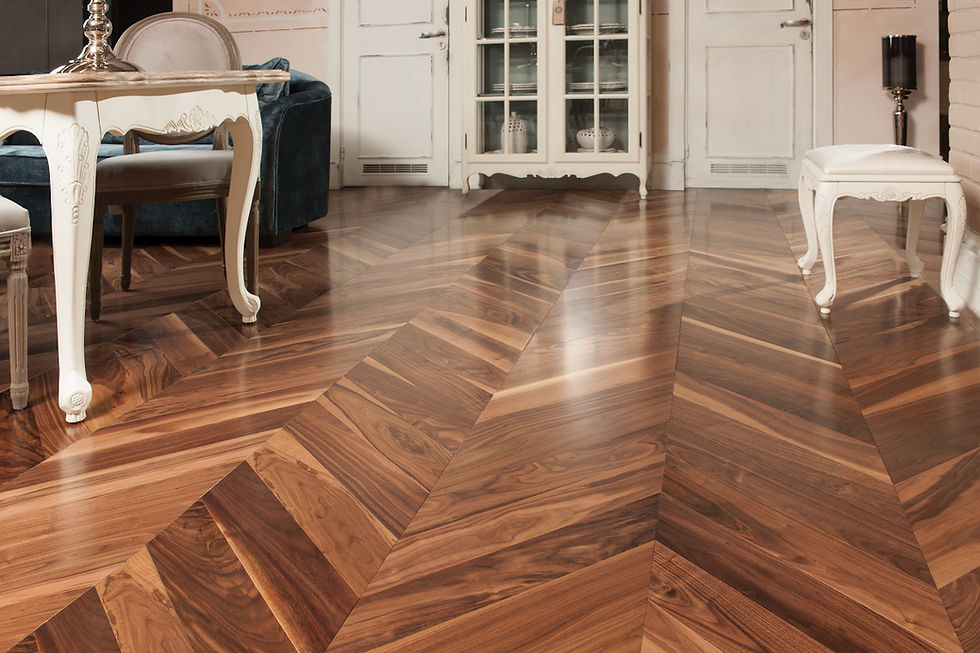
Herringbone or chevron for your Palm Beach home? Joe Avila, NWFA-certified, compares look, layout, slab installation and what drives the cost of each.
Planning a project? Talk with Joe Avila: call 908-232-6600 or book a virtual consultation.
Herringbone and chevron are the two patterns Palm Beach clients ask about most, and they are easy to confuse from the doorway. Herringbone boards meet at a right angle in a staggered, woven zigzag. Chevron boards are cut at an angle so their ends meet in a clean point, like a row of arrows. The right choice depends on the architecture of the house, the shape of the room and where you want the eye to travel. This guide explains how each pattern reads, how it is laid out, how it is installed over a Florida concrete slab, and what moves its cost.
Two Patterns That Look Alike From the Doorway

From across a room, herringbone and chevron can seem like the same idea. Up close they are built differently, and that difference changes how the floor feels.
In herringbone, each rectangular board butts against the side of the next at 90 degrees. The ends are square. The pattern steps along like woven fabric, and the eye moves in a gentle zigzag across the room.
In chevron, the ends of every board are cut at an angle, most often 45 degrees, sometimes 30 or 60. Two boards meet tip to tip, so the pattern forms a continuous line of points that pulls the eye in one direction. Neither is better. They suit different rooms and different architecture. Our earlier overview, herringbone and chevron: what you need to know, covers the history of both.
How Each Pattern Reads in a Palm Beach Room

Palm Beach houses range from Mediterranean Revival villas in the tradition of Addison Mizner to crisp new builds along the Intracoastal. The pattern should follow the architecture.
Herringbone has deep roots in European houses and fits Mediterranean Revival, Regency and classic Georgian interiors. It is forgiving in rooms with many doorways because it has no single direction to fight.
Chevron suits long galleries, entry halls and contemporary rooms with clean lines. Its arrows point somewhere, so it works best when the room has an obvious axis, such as a hall that runs toward the water.
A useful test: stand in the main doorway and ask where you want the eye to go. If the answer is out to the view, chevron aimed toward the windows can lead it there. If the answer is around the room, herringbone is calmer. In an open plan, many clients keep one pattern throughout so the floor reads as a single surface. See more ideas in what wood flooring pattern is best for you.
The Specialist Detail: Layout Starts at the Centerline

The success of either pattern is decided before the first board is glued. An installer snaps a working line down the center of the main room, then checks it against the walls, the fireplace, the front door and the longest sightline. In older Palm Beach houses, walls are rarely perfectly square, so the line is set to the feature you see first, not to the nearest wall.
Herringbone is milled in left-hand and right-hand boards, often called A and B. They are laid in pairs off that centerline. Mixing them up, or letting the line drift a few millimeters over a long room, shows up as a crooked pattern at the far wall.
Chevron is less forgiving. Because the board ends meet in points, any drift opens a visible gap at the tip. Good chevron boards are milled with precise angled ends, and a careful installer dry-lays several rows to confirm the points close before spreading adhesive. Ask any installer you interview how they plan the centerline and the borders. The answer tells you a great deal about the finished floor.
Weighing species, pattern or finish? Talk it through with Joe Avila.
Borders, Thresholds and Transitions

Patterned floors usually need a border, a frame of straight boards around the edge of the room. It hides small irregularities in the walls and gives the pattern a finished edge. In a house with stone terraces and marble baths, the border is also where the wood meets other materials, so its width and species deserve as much thought as the pattern itself.
Will the pattern run continuously from room to room, or stop at each doorway with a threshold?
Where does the pattern meet stone or tile, and at what finished height?
Should the border be the same species, or a contrasting one such as walnut around white oak?
Do stair nosings and landings need matching pieces?
Species and Finish for Coastal Light

White oak is the most common choice for both patterns because it is stable and takes stain and oil evenly. Walnut gives a deeper, warmer floor but is softer and lightens in strong sun over time. European oak, cut from slower-grown trees, has a tighter, quieter grain that many clients prefer for patterned work, because the pattern rather than the grain carries the room.
South Florida light is strong. A matte or low-sheen finish hides fine sand and wear better than gloss, and it keeps the pattern reading as texture rather than glare. See our comparison of white oak, red oak and walnut for how each species ages, and browse The Herringbone Collection and The Chevron Collection.
Installing Over a Concrete Slab

Most homes from West Palm Beach to Jupiter sit on concrete slabs. Engineered herringbone and chevron, with a real wood top layer over a stable plywood core, are glued straight to the slab. Solid patterned boards generally need a plywood subfloor first, which raises the floor height and the cost.
Before any adhesive goes down, the slab is tested for moisture and the right membrane is chosen. Humidity matters after installation too: keep the air conditioning running when a seasonal house is closed. Read wood flooring over a concrete slab in South Florida and the best wood flooring for Palm Beach humidity before you commit.
Have a floor plan or a floor that needs attention? Joe Avila can review it with you.
What Drives the Cost

We do not quote prices without seeing the room, but these are the factors that move a patterned floor's cost:
Pattern: chevron usually takes more labor than herringbone.
Board size: smaller boards mean more pieces, and more cuts, per square foot.
Species and grade: European oak and select grades cost more than character grades.
Borders and inlays: each adds layout time and material.
Slab preparation: moisture control and leveling come before the floor.
Finishing: prefinished boards install faster; site finishing gives a seamless surface and a custom color. See prefinished vs. site-finished floors.
Patterned floors also need more waste allowance than straight planks, so order carefully. Our guide to how much wood flooring to order explains the math. To see both patterns in your own light, request a sample box.
Quick Answers
What is the difference between herringbone and chevron? Herringbone boards have square ends and meet the side of the next board at 90 degrees, forming a staggered zigzag. Chevron boards have ends cut at an angle, most often 45 degrees, so two boards meet tip to tip in a continuous point.
Which pattern looks more formal? Chevron reads as more tailored and directional because its points form one clean line. Herringbone feels woven and slightly more relaxed, and it suits rooms with many doorways.
Which costs more to install? Chevron usually takes more labor, because every angled board end must meet its partner exactly. Board size, species, borders and slab preparation also move the cost, so a quote depends on the room.
Can herringbone or chevron go over a concrete slab? Yes. Engineered herringbone and chevron are glued directly to a tested, prepared slab, which is how most Palm Beach homes are built. Solid patterned boards usually need a plywood subfloor first.
Talk to a Palm Beach Wood Flooring Specialist
Call Joe Avila at 908-232-6600 (9 a.m. to 5 p.m. Eastern), email joe@hugginsflooring.com or book a virtual consultation. You can also explore inspections and consultations, wood flooring samples and our collections.
About The Author
Joe Avila leads Palm Beach Wood Floors, a Huggins Wood Floor Specialist brand, and brings 26 years of hands-on wood flooring experience. He is an NWFA-certified wood flooring inspector, installer and sander, and for more than a decade he has taught accredited continuing education programs for AIA, ASID and IDCEC audiences, training thousands of architects and design professionals in the proper specification of wood flooring.


Comments